John R. Ladd
I’m an Assistant Professor in Computing and Information Studies at Washington & Jefferson College, where I teach and research on the use of data across a wide variety of domains, especially in cultural and humanities contexts. I also build research tools, write data science tutorials, and make small, weird web projects.
In my research I think about the long, interwoven histories of media and technology from the early modern period to today. I’m currently working on a book about social networks and literary collaboration, called Network Poetics, which argues that shifts in the networks of 17th century print production allowed for the emergence of new literary forms.
I’m an active member of several long-running computational humanities projects and research groups, including Print & Probability, TRACE: Tools and Resources for Analysis of Early English Books Online (see: EarlyPrint), and the Cultural Analytics Research & Teaching Initiative (CARTi).
Some Recent Work
Publications
A few of my most recent publications:
-
English Language Notes, 64.1, 169–178, 2026
Abstract
Since the release of ChatGPT in November 2022, large language models (LLMs), once the purview of machine learning experts, computational linguists, and cultural analytics scholars, have entered the public discourse. Many different metaphors have been used to describe these models, and all of them reach past thinking of large language models as simply instruments for using language (or, as the companies that sell chatbots would have it, as artificial intelligence itself)—instead, many scholars ask us to consider the model as something that both uses language and is made of language. This essay will contextualize the history of LLMs within a larger history of compilation in text technologies and the digital humanities. In this broader historical view, it is possible to understand LLMs as programs that use compilations as training inputs to produce compilations as readable output but are not themselves compilations within their model architecture. The metaphor of compilation is useful, alongside the many other metaphors used to understand these often-opaque models, as a way of capturing the historical continuities in how language models are trained and how their outputs are read.
BibTeX
@article{ladd_inputoutput_2026, title = {Input/{Output}: {LLMs}, {Compilation}, and the {History} of {Text} {Technologies}}, volume = {64}, issn = {0013-8282}, shorttitle = {Input/{Output}}, url = {https://doi.org/10.1215/00138282-12301864}, doi = {10.1215/00138282-12301864}, number = {1}, urldate = {2026-07-06}, journal = {English Language Notes}, author = {Ladd, John}, month = apr, year = {2026}, pages = {169--178} } -
Milton Studies, 68.1, 88–112, 2026
Abstract
ABSTRACT. Milton’s writing understands and disassembles data as a source of certainty. His use of data (yes, he used data frequently in his work) and his understanding of the data-obsessed movements of his own historical moment show a writer attuned to the successes and failures of technological and scientific developments. With characteristic anxious subtlety, Milton attempts to manage the pressures and contradictions of data-focused uncertainty. Paradise Lost takes up thematic and formal gestures toward seventeenth-century scientific discourse, including many discussions on the nature of knowledge. These gestures can be made more legible by using computational methods to highlight overlooked word- and line-level features of Milton’s verse. Employing both quantitative and qualitative approaches to examine Paradise Lost and the history of the term data in the early modern period, this article shows that Milton’s understanding of the precarity of knowledge is rooted in a complex engagement with data of various forms.
BibTeX
@article{ladd_miltons_2026, title = {Milton’s {Precarious} {Data}}, volume = {68}, issn = {0076-8820}, url = {https://dx.doi.org/10.5325/miltonstudies.68.1.0088}, doi = {10.5325/miltonstudies.68.1.0088}, language = {en}, number = {1}, urldate = {2026-07-06}, journal = {Milton Studies}, author = {Ladd, John}, month = feb, year = {2026}, note = {Publisher: Duke University Press}, pages = {88--112} } -
AI for Humanists, 2025
BibTeX
@misc{ladd_working_2025,
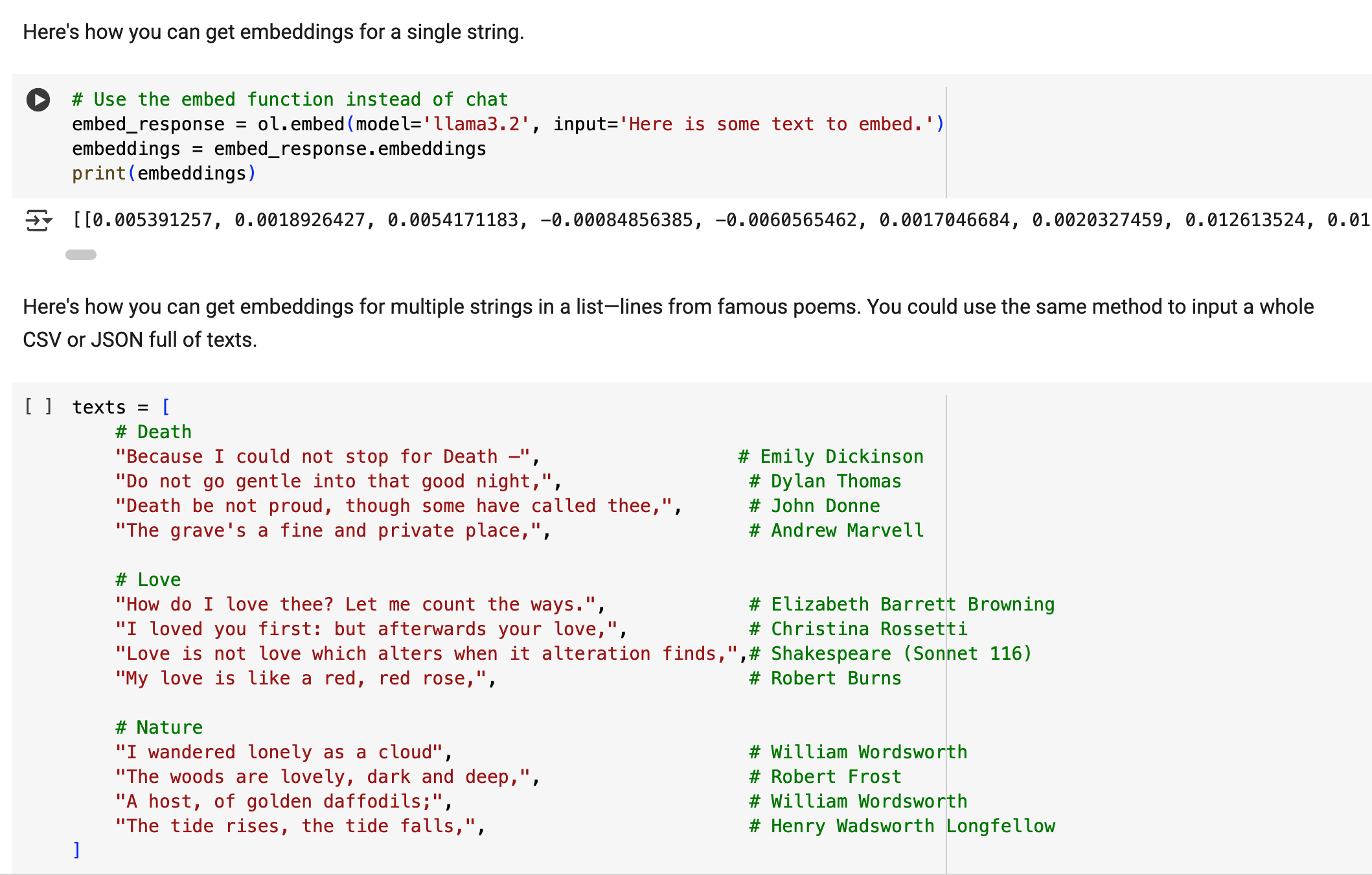
  title = {Working with {Local} {LLMs} ({On} {Your} {Own} {Computer}!)},
  url = {https://colab.research.google.com/drive/1V09aQmReB1iMDuTLIWArWODGbHlOK-kQ?usp=sharing},
  journal = {AI for Humanists},
  author = {Ladd, John R. and Walsh, Melanie},
  month = jun,
  year = {2025}
}