Human and Machine Intelligence in Networks of Early Modern Print

John Ladd, jrladd.com/slides/machine-networks

spacebar for next slide, arrow keys to navigate, esc/menu for overview

Did 17th century printers have “lines”?

Why should we care?

  • Interlinked circumstances of text production
  • Printers’ selection, agency, and motivation
  • Understanding clandestine printing

An example: Locke & Spinoza

Robert Everingham and Thomas Braddyll

Today’s Talk

  • Human and Machine Expertise
    • Computation in EM Studies
    • LLM research methods in the humanities
  • Who Printed What?
    • Critical metadata analysis
    • Structured language and entity extraction
  • Printers’ Lines
    • Document embeddings and text similarity

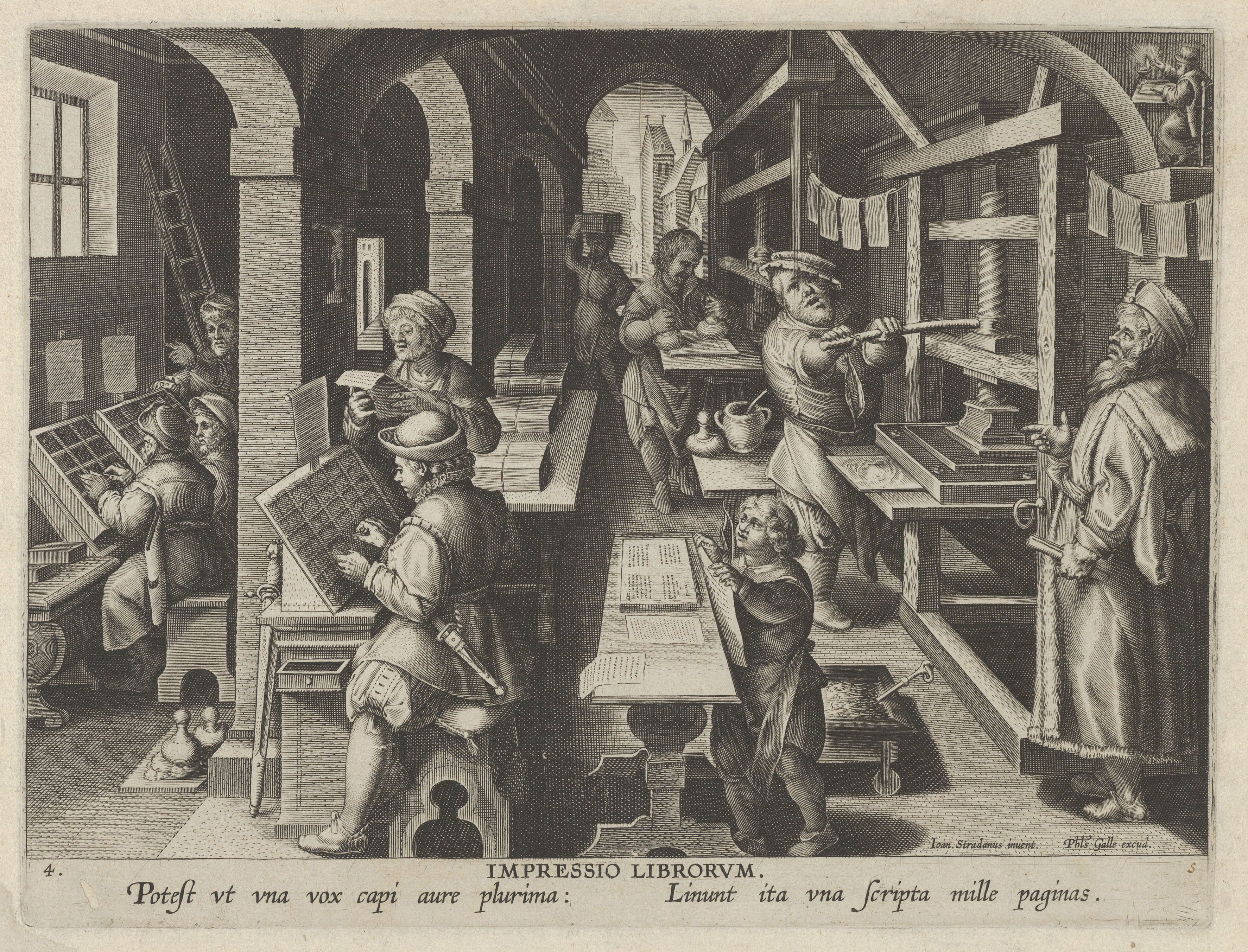
Human and Machine Expertise

In the Printshop

Metropolitan Museum of Art

Computation in Early Modern Studies

How can LLMs help us?

What’s different for early modernists?

Who Printed What?

Building the Network

Working with Imprints

Approaches to Parsing Imprints

  • Human reading
  • Regular expressions
  • Traditional natural language processing
  • Fuzzy search
  • Large Language Models?

Local LLMs for Imprint Parsing

Working with Local LLMs (On Your Own Computer!)

All this only gets us the known printers!

And it doesn’t tell us what kinds of texts they were printing.

Printers’ Lines

Finding similar texts by content

  • Normalization and regularization
  • Term Frequency–Inverse Document Frequency
  • UMAP and t-SNE
  • Cosine Distance

These simple methods power a range of tools for exploring text corpora.

Ngram Viewer

Discovery Engine

Bibliographia

Using this approach to map restoration printing.

Tf-Idf Wordcounts

LLM document embeddings (titles)

What is a document embedding?

  • Contextual embeddings combined into a single vector for each document
  • Frequently used as an intermediate step (for RAG)
  • Vectors can be used in place of wordcounts/Tf-Idf scores/LDA topics

Viewing Braddyll and Everingham with Tf-Idf

Viewing Braddyll and Everingham with LLM Embeddings

Testing Our Hypothesis

  1. If printers have lines, we would expect that texts printed by the same person are more similar than randomly-selected sets of texts.
  2. Using a resampling procedure, we can compare sets of texts printed or published by specific individuals to the distribution of random sets of texts.
  3. The metric used for comparison is the ratio of the number of texts in each set that are among the top ten nearest neighbors of any other text in the set to the total number of texts. In other words, what percentage of texts in each set are close neighbors with one another?

Exploring Braddyll and Everingham Individually

Total Braddyll texts: 67
Texts with close neighbors from the same set: 18
Ratio of close neighbors: 0.27

Total Everingham texts: 37
Texts with close neighbors from the same set: 7
Ratio of close neighbors: 0.19

Viewing Braddyll and Everingham as a Unit

Total Braddyll/Everingham texts: 98
Texts with close neighbors from the same set: 23
Ratio of close neighbors: 0.23

If printers do have lines, why does this happen?

  • physical proximity
  • profit motive
  • network affects
  • interests, beliefs, ideology

from Raven, James, Bookscape: Geographies of Printing and Publishing in London Before 1800 (2014).

Does clandestine printing follow different rules?

Conclusions and Next Steps

LLMs represent an extension of cultural technologies rather than a radical break.

A human-in-the-loop process that combines researcher expertise with computational approaches at varying scales.

LLM-based methods can fit into existing workflows for computational early modern scholarship.

Spelling regularization, structured language parsing, and document embeddings are a solid start.

Understanding how LLMs work is worthwhile even if your research isn’t about LLMs.

The culture-mapping abilities of modern language models are useful beyond the novelty of the methods.

Thank you!